 Tiago Inês
- 30 Aug, 2026
Best Worship Planning Software in 2026: SongBook Pro vs OnSong vs Planning Center vs JustChords vs Hosanna
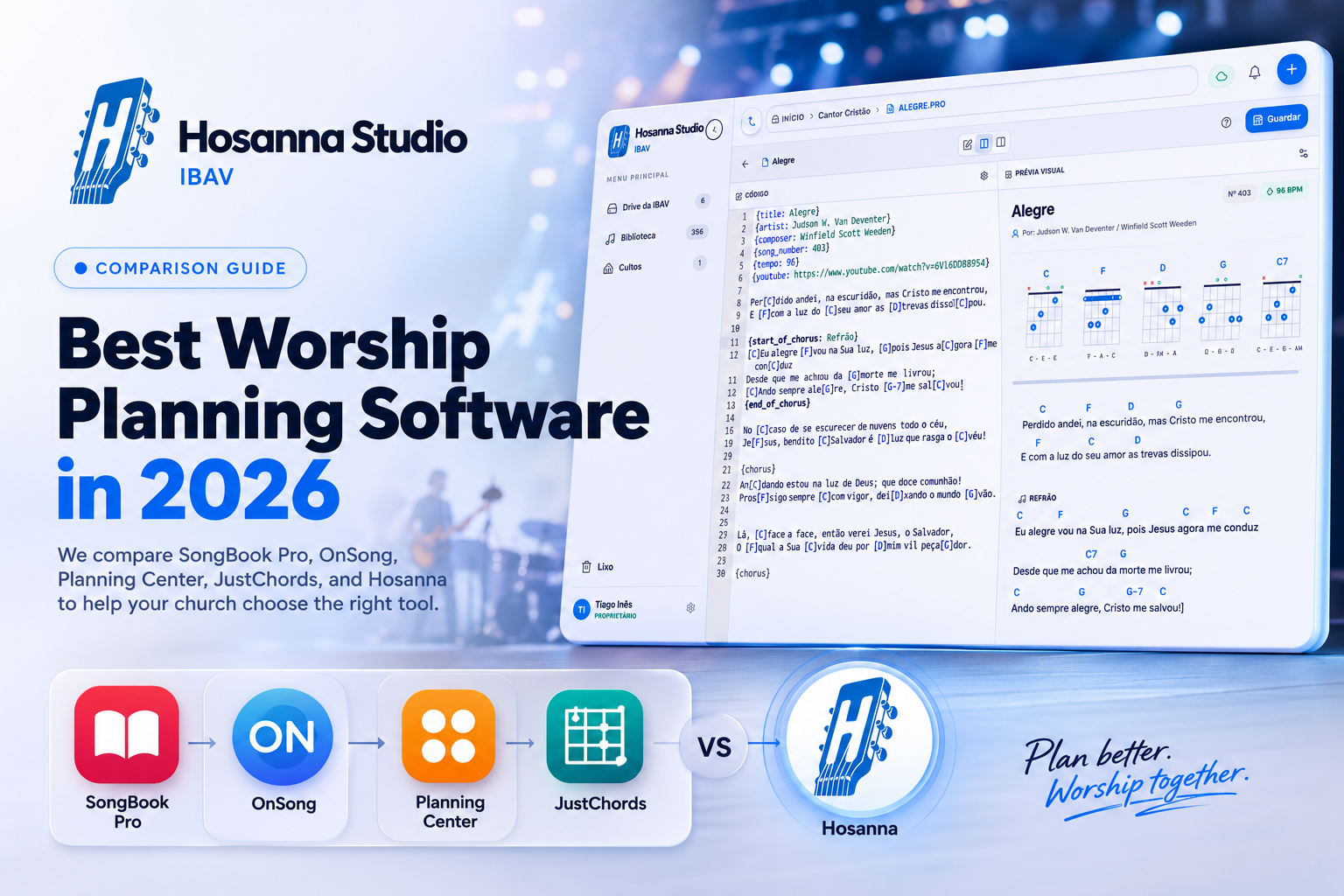
Best Worship Planning Software in 2026: SongBook Pro vs OnSong vs Planning Center vs JustChords vs Hosanna Choosing software for your worship team usually starts with the same question: do I need a chord chart app for musicians, or a planning tool for the whole team? Most churches end up buying two or three separate tools to cover both jobs — one app for chords and transposition, another for scheduling and service planning, and a spreadsheet or group chat to glue it all together. This guide compares five popular options — SongBook Pro, OnSong, Planning Center (Services + Music Stand), JustChords, and Hosanna — so you can see where each one fits, what it costs, and what it doesn't do. Quick comparison SongBook Pro OnSong Planning Center JustChords HosannaBest for Solo musicians, gigging players Solo musicians, bands, live performers Full church management + scheduling Solo/small-group chord charts Whole worship team + service planningPlatform iOS, Android, Windows, Fire iOS/iPadOS/Mac only Web + mobile apps iOS, iPadOS, Mac Web (Studio) + iOS/Android mobileSong format ChordPro, OnSong, PDF ChordPro, PDF, MIDI Own format + CCLI/SongSelect import ChordPro-based ChordPro (native)Service/setlist planning Basic sets only Sets/setlists only Full service planning + volunteer scheduling Setlists only Full service planning (songs + readings, sermon notes, announcements)Team/role management No Group plans, shared library Yes, extensive No Yes, roles + teams built inOffline mode Yes Yes Limited (Music Stand) Yes Yes, offline-first by designPricing model One-time (~$7) or Groups subscription Per-user, tiered ($2–$60+/mo by group size) Modular, per-app, scales with team size Per-user (app store) Flat €12/month per church, unlimited usersSongBook Pro SongBook Pro is a long-running digital songbook app built for individual musicians who want to get rid of paper binders. It reads ChordPro, OnSong, and PDF files, supports transposition and capo adjustments, and lets you group songs into sets for a gig or rehearsal. The Solo edition is a one-time in-app purchase (roughly $7) after a 12-song free trial. SongBook Pro Groups is a separate subscription product with a web-based manager, shared library sync, and permission settings for bands. Where it's strong: price, offline reliability, and flexibility around file formats — it happily imports from UltimateGuitar or WorshipTogether as well as ChordPro. Where it falls short: it's fundamentally a chord-chart viewer, not a service planner. There's no concept of a full worship service with readings, sermon notes, or announcements — just songs and sets. Team communication and role-based access are minimal even in the Groups tier. OnSong OnSong is one of the most established names in the "digital binder" category, popular with both worship bands and solo performers. Beyond chords and lyrics, it adds performance features like autoscroll, MIDI/foot pedal automation, stage lighting triggers, and backing-track playback — genuinely built for live performance, not just planning. Pricing is per-user and tiered by group size: Solo Essentials runs as low as $2/month billed annually, while group plans scale from around $19.99/month for up to 5 users to $99.99/month for up to 50 users on a church campus plan, all requiring Apple hardware (iPad, iPhone, or Mac only). Where it's strong: live-performance polish — automation, MIDI, and stage tech integrations most competitors don't attempt. Where it falls short: Apple-only, which locks out any team member on Android or Windows. Pricing also scales per user, so a growing worship team's bill climbs with headcount rather than staying flat. Like SongBook Pro, it's oriented around songs and sets, not full-service structure (sermon outlines, readings, announcements). Planning Center (Services + Music Stand) Planning Center is the closest thing to an industry standard for church operations broadly, not just worship. Services is priced by the number of team members who need access and by file storage, with Music Stand as an add-on for musicians. The People module is free with unlimited database and reporting, and Services starts with a small number of free team members before paid tiers kick in. Because Planning Center is modular, churches often end up combining several of its products (People, Services, Check-Ins, Giving, Calendar) to get full functionality — and Services alone is commonly priced around $15/month, with a median all-in contract cost near $759/year across surveyed churches. Where it's strong: breadth. Volunteer scheduling, service order, CCLI/SongSelect integration, and church-wide operations all live in one ecosystem, and Music Stand gives musicians a chord-chart companion. Where it falls short: cost and complexity scale together. Because pricing is modular and usage-based, a mid-sized church wanting Services plus a couple of adjacent modules can land well above flat-rate alternatives, and the system is built for whole-church administration — a lot of surface area if a worship team just wants song and service planning without the rest of the church-management stack. JustChords JustChords is a newer, actively developed chord-and-lyrics app for iPhone, iPad, and Mac. It lets musicians manage songs with chords, lyrics, notes and tabs, import from the web or other apps, and organize with tags and artists, while adjusting font size, layout, and color before transposing to any key or setting a capo. It also supports setlists with reordering and sharing, AirPlay lyric mirroring for a stage screen, a metronome and tuner, and Bluetooth/MIDI pedal support for hands-free page turns. Where it's strong: a modern, well-designed single-musician experience with strong stage-performance tooling (AirPlay mirroring, AUv3 plugin support, pedal integration). Where it falls short: it's Apple-only and squarely a musician's chart app rather than a team-planning tool. There's no service structure beyond setlists, no non-song service content, and no organization-wide role or subscription management — each musician is essentially on their own app. Hosanna Hosanna takes a different starting point: instead of asking "how do I view my chords," it asks "how do I plan and run the whole service, then get every musician the right material." The song library is ChordPro-based (so it's portable and compatible with the broader ChordPro ecosystem), with transposition and chord visibility handled per-musician — one player's key change or hidden chords never affects anyone else's view. On top of the song library sits full service planning: songs, Bible readings, sermon outlines, and announcements can all live in the same service timeline, which is aimed less at worship leaders alone and more at pastors and service coordinators too. Everything syncs across the web-based Studio and the mobile app, and the mobile app is built offline-first, so a dropped Wi-Fi connection mid-service doesn't take down the material musicians already synced. Pricing is flat: €12/month (or ~€120/year) per church, with unlimited musicians and dashboard users — the only paid add-on is for additional campuses. There's no per-user counting and no feature-gated tiers to navigate. Where it's strong: it's the only option here that treats the entire service — not just the setlist — as the planning unit, at a predictable flat price regardless of team size. Where it's still maturing: Hosanna is newer to market than Planning Center or OnSong, so its integration ecosystem (SongSelect, third-party chart marketplaces, stage lighting/MIDI automation) is not as deep yet as OnSong's or as broad as Planning Center's. Which one should your church actually use?A solo musician or small acoustic act who just needs chord charts and doesn't touch team scheduling: SongBook Pro or JustChords cover the basics cheaply. A band that wants live-performance automation (MIDI, lighting, backing tracks) and is fully on Apple hardware: OnSong. A church that wants one system for everything — check-ins, giving, volunteer scheduling, and worship planning — and doesn't mind modular, usage-based pricing: Planning Center. A worship team or church that wants the whole service planned in one place — songs, readings, sermon notes, and announcements — synced across web and mobile, offline-capable, at one flat monthly price regardless of team size: Hosanna.There's no single right answer — it depends on whether your bottleneck is chord charts or coordinating the whole service. Worth trialing the free tiers of a couple of these before committing your team's workflow to one.
- Tiago Inês
- 31 Jul, 2026
Why We Started Building Hosanna
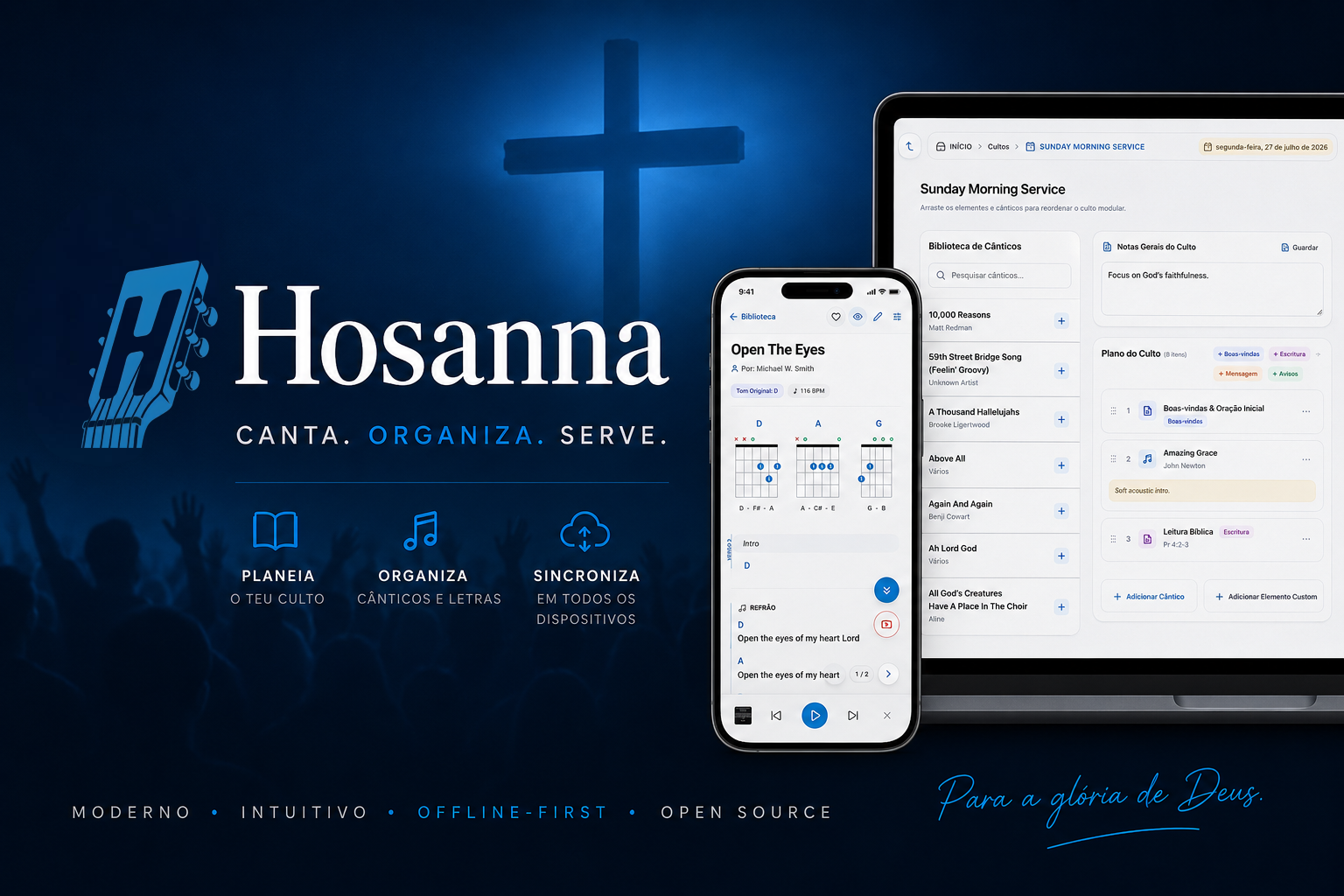
Why We Started Building Hosanna The beginning of a project that started with a simple idea: worship software should be better. Hosanna didn't start as a company, a SaaS platform, or a big product roadmap. It started with a much simpler problem. There are plenty of tools for musicians. There are plenty of applications for displaying lyrics and chords. There are even some very capable applications for churches. But after using some of them, it became increasingly obvious that there was room for something different. We wanted something modern, open, flexible, and built around the way churches actually work. The original idea was heavily inspired by applications such as Songbook Pro and OpenSong. These tools demonstrated that having a digital songbook could be incredibly useful, but we wanted to take the concept further. The goal was not simply to make another application that displays chords. The goal was to build an ecosystem for worship teams. Starting with ChordPro One of the first decisions was to use ChordPro as a foundation. Instead of storing songs in a proprietary database format, songs could be represented as text. That made them portable, editable, versionable, and easy to work with. It also meant that the actual song remained understandable outside of the application. That principle became important very early: Your songs should belong to you. From there, the project began taking shape around a proper ChordPro formatting and rendering engine, including chord transposition and the ability to turn simple song files into something designed for musicians. At that point, Hosanna was still very much an experiment. There wasn't a polished dashboard. There wasn't a service planner. There wasn't an online platform. There certainly wasn't a website announcing a finished product. There was just a codebase and a growing list of things that would be useful. More than a songbook As development continued, the scope naturally expanded. A church doesn't only need a list of songs. It needs to organise those songs. It needs to prepare services. It needs musicians to be able to access the same material. It needs information to remain available even when the internet isn't perfect. And, most importantly, it needs the software to stay out of the way when worship actually starts. That changed the direction of the project. Hosanna stopped being just an experiment in building a better songbook and started becoming something much bigger. The architecture began separating the mobile application, dashboard and server. Shared functionality was extracted into reusable packages. Local storage and caching became important parts of the design. The project was becoming an ecosystem. Still only the beginning Looking back, the early versions of Hosanna were very different from what we're building now. That is probably the most interesting part. Many of the things that now feel obvious started as small experiments, half-finished ideas, or problems that needed solving. Hosanna is still evolving. But the original principle hasn't changed: Build tools that help the church, don't get in its way. This is the story of how we're trying to do that.